
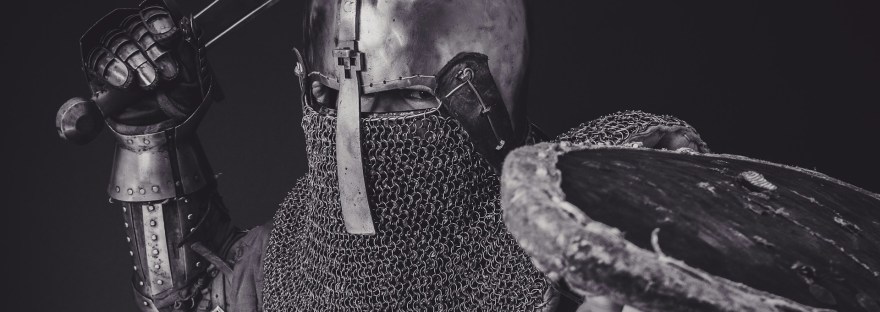
Paul told Christians to use the Armor of God to fight against the “evil tricks” of our spiritual enemy: “Put on the full armor of God so that you can stand against the schemes of the devil” (Ephesians 6:11, CSB).
It is always interesting to see how far preachers and teachers will go with their illustration of the armor. Will be it Medieval or Roman in style? Are they going to put it on piece by piece, or have someone else model it for us? I recently thought a preacher could use a Minecraft type of “armor stand” to help us see each element for more than a few seconds.
If we walked around, dressed in a visible set of the Armor of God, we would be an impressive sight. But what good will the Armor do us if we do not know how to attack or defend? What if we are short-circuiting the power of our primary weapon?
Armored and Armed
Whenever I see photos or film of a mansion or castle, I keep an eye out for suits of armor. They appear so regal, official, and deadly, as they stand with their weapons at the ready to defend their home.
I recently rewatched the Lord of the Rings films. The costume designers worked hard to create unique armor for each race and kingdom. From the Celtic-style knots of the dwarves to the smooth lines of the elves; from the imagery of the horse lords to the emblem of the white tree accompanied by its stars.
Armor is fun to look at it but is meant to be worn. In stories and film the armor only comes out for a battle and then put away again. The Armor of God is meant to be worn continually.
God’s truth is required throughout the day, discerning lies and temptations. Our salvation is not situational, it is our new way of life. We can only “pray at all times” if we are always praying (a theme Paul repeated in other letters).
We do not only “put on” the Armor of God but stay in the Armor of God. Helmet, belt, shoes, shield; always on and in place. And we keep the sword of the Spirit at hand.
Maybe you have the same imagery in mind as I do: a sword in its sheath, hanging from the user’s belt. It is always there, waiting to be put to use. It pulls quickly and cleanly from the casing, literally as strong as steel, able to cut to (or through) the bone.
Again we think of it in use only occasionally. It would be too difficult to go through the tasks and travels of daily life with a sword in our hand. Right?
Nehemiah was a governor in Jerusalem when the people of God were returning from exile to the Promised Land. His heart broke for the physical condition of the city with its broken walls and burned gates. Godless neighbors opposed the rebuilding of Jerusalem’s defences and sought to disrupt the repairs.
From that day on, half of my men did the work while the other half held spears, shields, bows, and armor. The officers supported all the people of Judah, who were rebuilding the wall. The laborers who carried the loads worked with one hand and held a weapon with the other. Each of the builders had his sword strapped around his waist while he was building … (Nehemiah 4:15-18)
Take Up the Sword
Writing to the Ephesians, Paul’s choice of word reflected more than having a sword at the ready. To “take” the sword of the Spirit goes deeper than drawing it from our side and into battle.
When Paul said to “put on” the armor of God, the word simply means to clothe, which is fairly easy to understand. We are to “stand” with the truth, righteousness, and readiness of the Gospel, where stand means to maintain, establish, continue, or remain firmly.
Ephesians 6:17 in most English translations begins with the phrase “And take“. (I love how Bible Gateway will show you all of the English translations of a verse at once.) There are a few notable exceptions.
Two newer translations read, “receive the helmet of salvation, and the sword of the Spirit” (emphasis added); the Legacy Standard Bible (LSB), which is an update in the chain of the NASB, and the Lexham English Bible (LEB). This is closer to the meaning of the word Paul used.
This word, dechomai is not a word that means to pick up, such as to lift or wield the sword, to remove it from its sheath and put it to work. That original word is analambao, and it appears in verse 13 when we are told to take up the Armor of God, and again verse 16 to take up the shield of faith.
The “taking” spoken of regarding salvation and the word of God is different. A better translation of dechomai is to accept or receive. W.E. Vine says it “signifies ‘to accept,’ by a deliberate and ready reception of what is offered”.
Salvation and God’s word are offered to us. We must accept or receive them. The implication is obvious with salvation. Only those who will receive the gift will be saved (John 3:16; Acts 10:43; Ephesians 2:8).
What about the word of God? How well do we receive and accept it for ourselves?
A Critical Flaw
When you appreciate the beauty and function of swords and blades, the process of making them is equally fascinating. So when I stumbled upon the show Forged in Fire, I became an instant fan. In addition to the design and forging of a usable hand weapon, each blade is tested to see if it will “make the cut.”
One of these tests is the strength test. For any number of reasons, the forged blade may develop a flaw which makes the steel brittle and useless. Some flaws are obvious while others are hidden under the surface. When a flawed blade hits a target, it snaps or shatters.
We impart our spiritual blade with a critical flaw when we do not fully receive and accept the words of God in the Bible.
Don’t move on yet. Consider that idea again. Our spiritual blade is weak and ineffective because we do not receive and accept the words of God in the Bible.
“If God is really God then He wouldn’t talk like that. He wouldn’t ask the Israelites to do that. He wouldn’t condemn people to Hell. He wouldn’t ask me to love Him more than my family. He wouldn’t tell me to forgive so-and-so who did such-and-such to me. That is not the kind of god I want to follow.”
An unwillingness to accept God as He reveals Himself by His word is a sign of immaturity, if not the absence of faith. Each time we say “I cannot accept this portion of God’s word,” we chip away at our weapon, eating at is edge, cracking its surface.
When we swing the sword it is not with the might of faith in the God of the impossible, Creator and Sustainer, King of kings, LORD of Angel Armies. That swing would smash the arm of the enemy. Instead we flail with our swords, weak because of our lack of confidence in God’s truth, unable to accept it as greater and better than our own wisdom.
We cannot pick and choose which part of the Bible to receive and accept. Either it is all true and necessary to equip us, or it does not matter and has zero power, making it completely irrelevant for us.
Take a Minute
The Sword of the Spirit is not ceremonially or decorative. It is intended as an offensive weapon against the enemy. As God’s word, it has all of the integrity and strength it needs to be effective. So long as we do not weaken its ability in our life by refusing to receive and accept it fully.
Are there portions of the Bible you have chosen to never read?
When the Bible comes across as difficult or confusing, or against what you think it should say, how to you determine which understanding is right?
Which message from the word of God do you struggle with most? What is hindering your acceptance of it?
Photo by Henry Hustava on Unsplash
 Chris MacKinnon